

A 2012 CLASSICAL MUSIC EXPERIENCE COMPOSED FOR IMMERSIVE LISTENING
What is "Four Dimensions"?
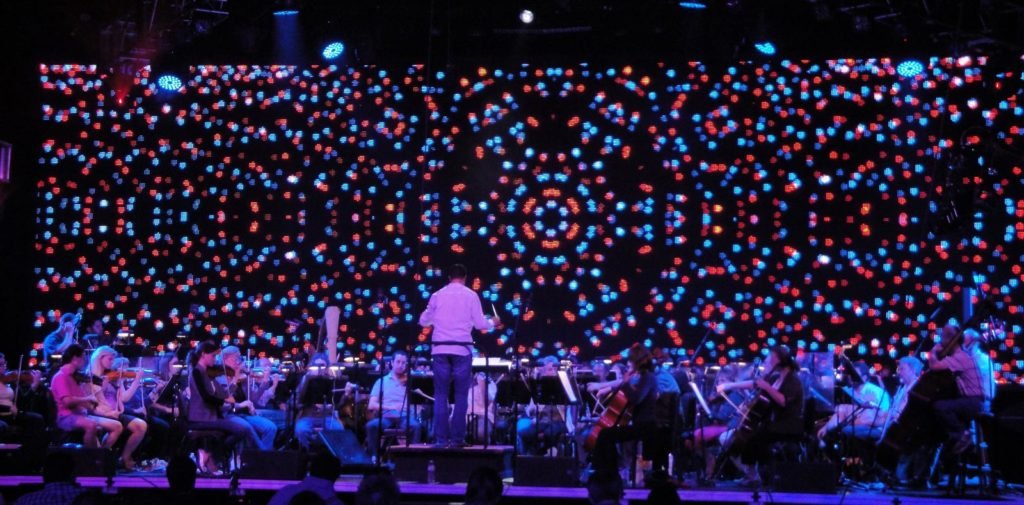
Four Dimensions is a seven-minute “orchestra concert work of the future” merging orchestra with modern music synthesis. The work was commissioned by the Orlando Philharmonic Orchestra in 2011 and performed at the newly constructed Venue @ Full Sail University on April 21, 2012 as a feature of the OPO’s annual Gala fundraiser.
An EWI (electronic wind instrument), performed by Brian Smithers, was added to the orchestra.
Seventy-two pre-rendered, detailed recordings of synthetically created music surrounding the audience were also added to the musical experience, produced to play back in full synchronization with the orchestra that was controlled by another added musician playing laptop computer using a bespoke application created for this piece.
Guest-conducted by Dirk Meyer – an excellent video recording of the performance and detailed description of the piece, score and technical means can be enjoyed from this site.
This work was later rearranged by A. Milyutin, and performed by TEREMA in St. Petersburg, Russia!
2012 Production and Results
The Gala event contained a great deal many other works and features and covered in by the Orlando Sentinel’s music critic Matt Palm. “Four Dimensions” was, by far, not the most important event in the production. Only two rehearsals totalling about 40 minutes was given to this fairly complex work.
Nevertheless, previous to the concert night, the highly professional production leaders, led by Darren Schnieder (audio) Vincent LePore (video), and Mike Stewart (live mix) carefully planned, staged and rehearsed every aspect of the show. The audio was sent from the Venue to be recorded in the Audio Temple, connected via fiber. There, an SSL Duality Hybrid console sent the signal to ProTools at 24bit 48kHz. My Max DSP expert Mark Pinsky and I sent the additional 6 audio channels of electronic music from my Apogee Ensemble/laptop to the huge list of mic and line signals. Another aspect of rehearsal was the preparation of Nathan Selikoff’s accompanying video for the rear LED billboard.
The performance had good energy, but, because of the limited rehearsal time, the orchestra was not fully prepared to deliver as an cohesive ensemble. Many passages in many instruments were not played. If a musician is not sure of their place in the music, they simply don’t play: putting notes and thythms in the wrong place is more damaging to the overall musical coherence than leaving the space empty. In addition, the conductor, Dirk Meyer, was a guest – not having the time to develop the musical rapport and comfort zone with the orchestra’s many individuals.
Even the long and impressive pro credit list/ experience held by the production teams could not completely overcome the compromises that had to be made. There were more musicians/ instruments than mic inputs leading to some pairs of instruments having a single mic – which led to poor direct signal from intended instruments and tons of bleed from the nearby instruments on the very crowded stage (especially percussion and brass). Mic adjustments became tedious and time-eating. And, this was the first time an orchestra had ever been heard in this multi-purpose venue, so surprises were bound to occur. Nonetheless, every string instrument was provided a DPA, other quality mics were everywhere, including two ambisonic Soundfields on opposite edges.
I had issues with the electronics, too. Foremost was its intonation. Somehow the output pitch was too high – almost like it was playing a 44.1kHz recording at 48kHz. The result was painful when it was to match brass and play simultaneously, which thankfully did not often occur. My original mix, currently on YouTube and this site, re-sampled all of the electronic segments to correct this pitch problem, but it still had to be mixed with the bleed of the original performance. The overall bleed, the missing of chord members, orchestration doubling and whole missing contrapuntal phrases were not significant enough to impede the overall success of my ‘official document’ of the media.
What is the purpose of this new atmos project?
Since the work was only performed once, a release-quality recording was never produced. My current challenge is to produce one in atmos using the tools at my disposal: atmos, traditional mixing techniques – and try out some new ones using Artificial Intelligence. It might not be successful because there are so many challenges to overcome. I’ll likely need help from my readers and be sharing my results.
I composed “Four Dimensions” to be immersive in sound, with musical elements heard from behind that merge and explore themes with the orchestra – to swirl, rise and fall; to integrate textures, evolve musical themes, and create a new, super- orchestral experience. The final atmos and 5.1 playback won’t just be the typical orchestra with room ambience from the back and sides. It will deliver the immersive experience that the music was designed to do – inspiring the imagination from all directions, pulling listeners into a continually expansive, interdimensional journey.
This Project's workflow
- Keep all original live tracks in Logic
- Freeze timecode in order to create a tempo/meter track for navigation and MIDI sampling and AceStudio AI
- Identify usable live close mics. (explore AI track instrument identification and splitting, to add to the traditional dynamic gating)
- Send or copy selected dry live (cleaned) tracks into MIR if they need a shared room.
- Export MIDI data from Sibeliius into Logic
- Build VSL replacements in VE 8 Pro.
- Use AceStudio AI to create separate instrument track realizations and decide if they should belong to the project
- Use dry/centered VSL sends feeding MIR to Place VSL, Ace, and selected live sources on the same MIR stage.
- Print MIR tracks/stems back into Logic.
- Use Logic Atmos for final presentation, not for re-positioning every instrument.
- Use Sony VME and Room B (or hire local studios) to judge the immersive result.
- Add 5.1 electronics tracks
- Final mixes in
- adm/bwf atmos Master 7.1.4
- Atmos -> binaural mp4
- 5.1 wav
- 5.1 flac
- 5.1 mp4
- Stereo .wav
- stereo mp3
Marketable products:
- A 7.1.4 TrueHD/Atmos encode in an MKV, because MKV can carry the TrueHD/Atmos bitstream without requiring me to author a physical Blu-ray disc.
- Sell the recording as an MKV from this site, ImmersiveAudioAlbum and any other available HiRes distributor
- Upload the .adm Master up to standard atmos streamers via Avid for Apple to create .mp4, for TIDAL to create joc
- Create a binaural mix for upload
- Create a standard stereo mix for upload