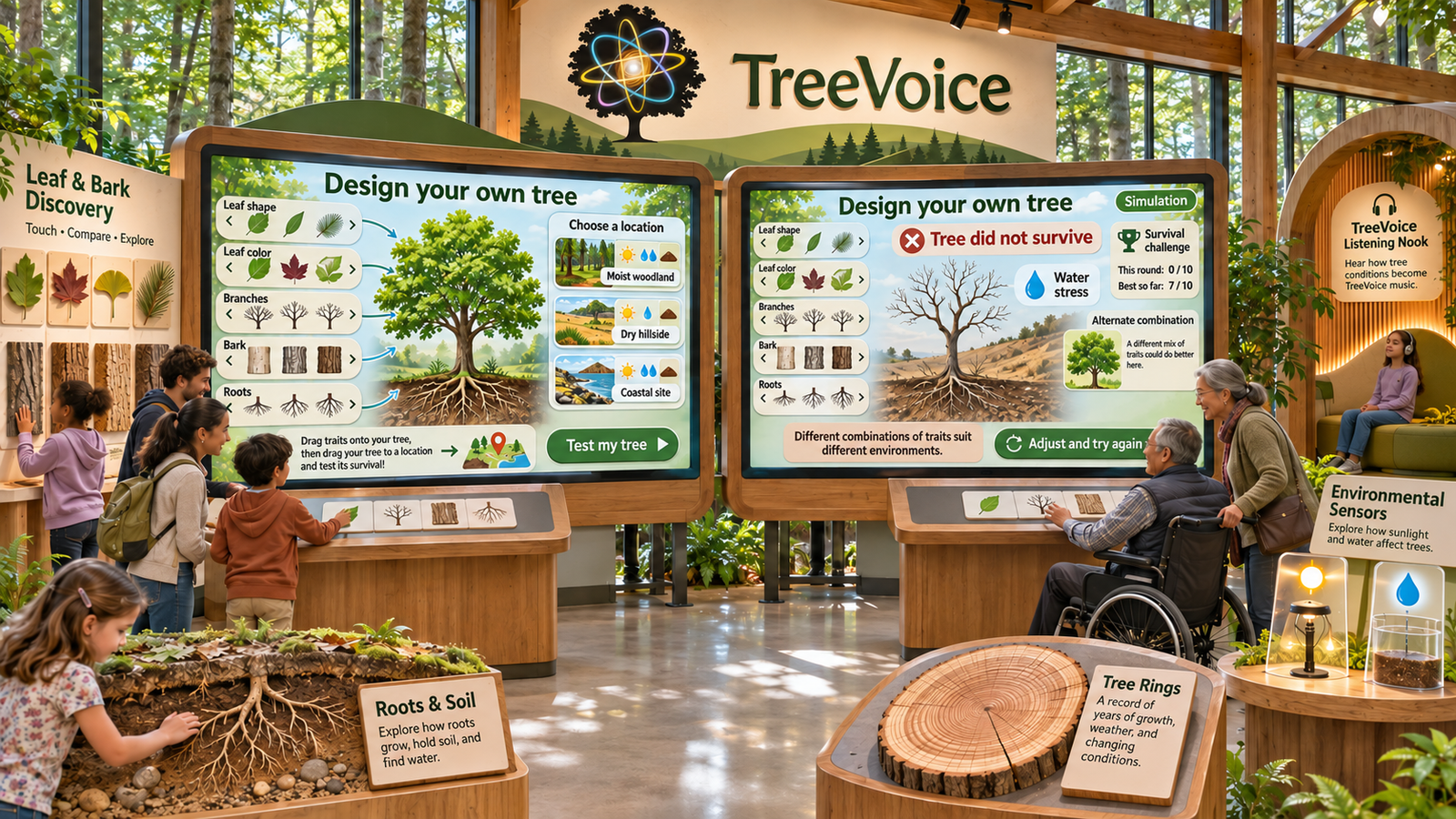


Listening guide
Imagine it’s 9:30 a.m. on a warm September morning. The six TreeVoices sing together in a major key, their musical lines moving upward.
• 0:20 — A gust of wind passes through the grove.
• 1:01 — A cloud crosses the sun. Each tree’s voice responds by moving downward in a minor key.
• 1:19 — A second gust moves through the grove. As the sky darkens, the minor key moves flatwise around the circle of fifths.
• 2:30 — The sun returns.
TreeVoice and Photosynthesis Potential
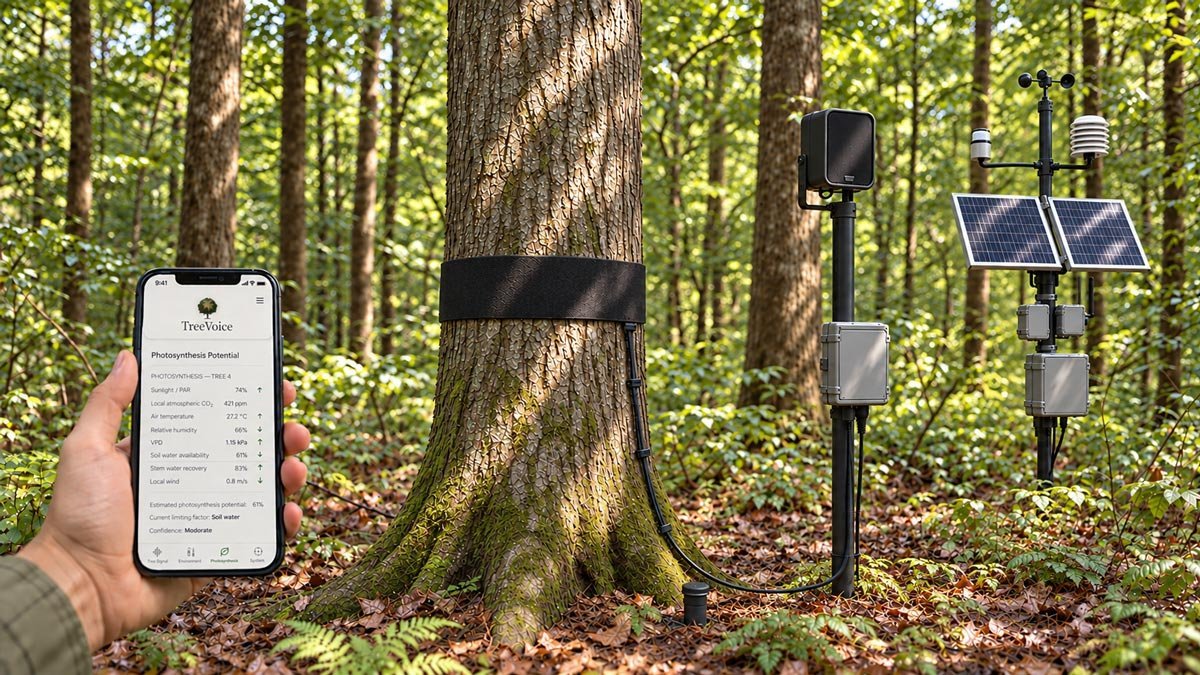
TreeVoice is being developed as a non-invasive, solar-powered instrument.
Light, temperature, humidity, atmospheric CO₂, soil-water conditions, wind and other measurements describe the tree’s surroundings inform a Photosynthesis Potential, Keith’s developing algorithm estimating how favorable those conditions are for photosynthetic activity.
Photosynthesis Potential shapes texture, melodic development, counterpoint and interactions among voices. Other measurements influence timbre, rhythm, articulation and dynamics. It is an estimate of environmental favorability, not a direct measurement of photosynthesis; field validation will guide its refinement.
A gentle presence among the trees
The installation design aims to avoid penetrating living tissue. Removable mounts, root-sensitive placement and ongoing inspection support an instrument that can be installed, observed and redeployed while leaving the tree physically undisturbed.
EarthVoice and the wider environment
TreeVoice began with experiments sonifying tiny electrical potentials from trees. That work remains part of its research history and may inform specialized studies, including electrical behavior around approaching storms.
EarthVoice is a proposed layer connecting each grove with larger environmental and geophysical processes through live or near-real-time scientific data. Potential sources include solar activity and solar wind, geomagnetic, magnetospheric and ionospheric conditions, and regional atmospheric change. Telluric and Schumann Resonance phenomena remain broader research interests.
These inputs would provide shared musical context alongside each tree’s local measurements. Their sources, geographic scale and data freshness would be identified on the iPhone user interface.